
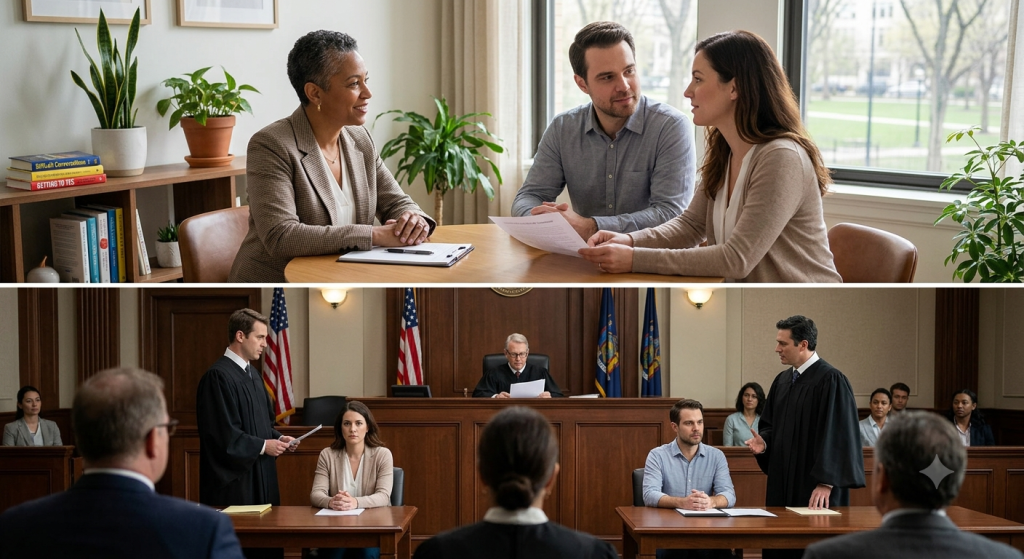
Most people go into conflict thinking they’re fighting for justice. Somewhere along the way though, the fight itself becomes the whole point, and you stop asking who’s right and start asking “What am I doing???”, “This is getting messy!”
So, what now? How do we prevent these questions from haunting us at 3am?
Well, decide: do I want to win the case, or do I want to end the war?
That’s basically the difference between litigation and mediation. A lawyer’s job is to figure out who’s right. A mediator’s job is different, and that is to discover what’s actually fair here, for both sides.
Sounds like a small distinction, but with very different outcomes.
There are definitely divorces where you need a lawyer first, no question about it. But a lot of people end up in the legal system without ever really asking whether their situation is a legal problem in the first place, or something else.
Take a marriage that has basically become transactional. No real emotional attachment left by the time it ends. Fine, get an attorney, work through the clauses, sign the papers, move on with your life.
But most divorces aren’t that. Most involve years of history, kids, a whole life built together, and that’s not really a legal dispute anymore.
It’s an emotionally loaded mess. And for that kind of situation, going straight to an attorney whose whole training is litigation probably isn’t the right first move.
I know that sounds harsh, but consider this:
Litigation-trained attorneys are genuinely good at what they do — analysing a dispute through a legal lens, figuring out rights, clauses and obligations.
But some conflicts need more than that. They need someone looking at the human side too.
Here’s how I think about it.
In most divorces, maybe 80% of what’s going on is emotional, and only 20% is actually legal — the assets, the paperwork, the technical stuff.
The 80% is things like: who said what, who did what, who gets the dog, who had the affair, who stopped listening years ago, who felt invisible in the relationship, and why they left the toilet seat up.
The remaining 20% is more like who keeps the jet ski, how the pension gets split, who’s paying the Netflix bill, and why they deserve the holiday home.
Attorneys are excellent at that 20%. Genuinely — the clauses, the loopholes, knowing what protections exist, and why section 600, line 2, word 99 applies to your case.
That’s real expertise.
But the actual problem, most of the time, is sitting in the other 80%.
Pain. Anger. Resentment. Feeling wronged, disappointed, unseen. And the law just doesn’t have a tool to deal with that level of conflict. It was never designed to.
Trying to fix emotional damage with a legal process is a bit like putting out a kitchen fire with a bulldozer. Yeah, technically, fire’s out. But look at the kitchen now.
When none of that pressure actually gets released, it comes out somewhere else.
Bitterness, bad-mouthing each other, retaliation, simmering resentment, hostility that drags on for years. That’s usually what you’re looking at when an emotional conflict only ever gets handled legally.
Same thing happens with attorneys who try to apply the litigation model in a mediation setting. Not saying they can’t do it well, plenty do. But their training is built around winning, and “who’s right” has a way of sneaking back into the room even when they’re trying to stay neutral.
It pulls them away from treating the situation as human, and back toward treating it as a procedure.
The law is blunt by design.
It exists to establish facts, rights, obligations, remedies. That’s its job.
Emotional conflict asks for something else entirely. People need to actually be heard. They need someone to dig into what happened underneath the argument, not just the argument itself.
So instead of only asking “what happened,” you end up asking why it happened, and what needs to happen from here.
Deal with the past properly and you’ve got a real shot at a future that isn’t dragging the same fight along with it. Settle the past, and in a strange way, you settle the future too.
Winning in a legal sense isn’t free, either. It comes with two costs — your lawyer, and your emotional trauma. That stays with you for years. Resentment shows up later as retaliation, spite becomes bitterness, anger turns into division.
The other difference between litigation and peace is that a judge can hand down a ruling, but a judge cannot give your children a childhood where their parents actually get along.
Custody can be split on paper perfectly, and none of that helps at a soccer match or a school play or a birthday party where the two people who made this kid still can’t be in the same room.
So sure, the law ends the lawsuit. You might even walk away with the house, the car, the dogs. Doesn’t mean the war’s over — that can keep running for another decade or two if nobody ever dealt with what was actually underneath it.
This is why picking the right mediator matters so much. Ask them how they work. Do they see things through a legal lens, or a human one?
A good mediator isn’t just there to get a signature on an agreement. They’re thinking about what happens afterwards. How to bring the retaliation temperature down, ease the tension, build something people can actually live with going forward.
None of this only applies to divorce, either.
Business partnerships, workplace fights, family issues, bad neighbours, even friendships — the same pattern shows up everywhere.
So before dialing a lawyer and rolling sleeves up for a fight, ask yourself what’s really driving it.
If it’s genuinely just money or assets or resources, fine, go to an attorney. But if there’s history in it? Love that curdled into resentment, respect that turned into contempt, money that’s now tangled up with pride and payback — well, that’s a mediation problem, not a legal one.
Too much of conflict resolution is obsessed with winners and losers. Most people, when you actually talk to them, don’t need to be right. They don’t even need to win.
They just want to be heard, and that’s where a good mediator helps translate the words and voice the concerns properly. What everyone needs is a way forward that doesn’t require carrying the fight with them for the rest of their lives.
The law can close a file. It’s a lot rarer for it to close a wound.
If you’re unsure whether your situation needs legal action, mediation, or a combination of both, get in touch for a confidential discussion about your options.



Why Winning in Court Could Feel Like Losing
When you’re in a serious dispute, the first usual thought is to get an attorney. And…

Should I use a mediator or an attorney for my divorce?
Most people go into conflict thinking they’re fighting for justice. Somewhere along the way though, the…
The Landmines found in Arguments
Words matter. And some words? They explode. Labels, blame, and absolutes can turn even the calmest…

The Danger of “Bad Words” in Communication
Certain words and phrases in conversation carry more weight than we realise. Labels like narcissist or…

Negotiation Is Chess, Not War
Many people approach negotiation like a fight, voices raised, egos at max, demands and half-baked threats…

Negotiation Skills Everyone Can Use
Negotiation isn’t limited to boardrooms or slick sales pitches. It’s for anyone trying to get someone…

Managing Disputes Without Losing Your Cool
Disagreements happen—whether it’s a business clash, a family argument, or someone taking your parking spot. Tempers…

7 Common Communication Mistakes
Effective communication is one of the most important skills in any relationship, whether at work, at…

Reading Between the Lines: Understanding Body Language
Humans communicate constantly, but not always with words. A twitching foot, a raised eyebrow, or crossed…