Something was damaged. Now there’s a bill to pay,
and nobody agrees on who should be responsible.
It might be a vehicle accident, a leaking pipe that
damaged a neighbour’s property, a contractor who
broke something while working, or expensive equipment
that was returned in pieces.
Whatever happened, the disagreement often comes down
to a few difficult questions: Who caused the damage?
What will it actually cost to put things right?
And who should pay?
Property damage disputes don’t always
need to become court battles.
Blackthorn Resolute helps individuals and businesses
discuss responsibility, examine the available
information and negotiate practical arrangements
for repairs, replacement or compensation.
Mediation does not mean either party must admit fault.
It creates an opportunity to explore a settlement
without immediately escalating the dispute.
What property damage disputes can we help with?
Property damage claims arise in homes, businesses,
neighbourhoods, rental properties and everyday
transactions. Common examples include:
Vehicle damage and accidents
Disagreements over collision damage, repair
quotations, excess payments, responsibility
and reimbursement.
Homes and residential property
Water leaks, burst pipes, flooding, damaged
fixtures, walls, ceilings and other repairs
where responsibility is disputed.
Damage allegedly caused during building,
plumbing, electrical, installation, maintenance
or repair work.
Landlord and tenant disputes
Disagreements about damage to rental premises,
reasonable wear and tear, repairs, and
deductions from deposits.
Machinery and business equipment
Damage to tools, machinery, refrigeration
equipment, electronics, vehicles, stock
or other business assets.
Goods damaged in transit or storage
Disputes about damaged deliveries, transported
goods, stored property and responsibility
between the parties involved.
Insurance-related disagreements
Negotiable disagreements over repair values,
assessments, reimbursement or settlement,
where the relevant parties have authority
to participate.
The real dispute isn’t always about what broke
Consider a leaking pipe that damages two properties.
One person says the pipe was poorly maintained.
The other says the damage was unavoidable.
A plumber quotes R8,000 to repair the pipe, while
a builder quotes R35,000 to repair the resulting damage.
Suddenly the argument isn’t only about a pipe.
It’s about responsibility, the extent of the damage,
whether the quotations are reasonable, and whether
the parties can trust each other’s information.
Mediation helps separate those questions so they
can be addressed individually instead of becoming
one enormous argument.
What can be negotiated?
Depending on the dispute and the parties’ rights,
a settlement might address:
Whether any responsibility is acknowledged
or disputed.
Which repairs are necessary and who will arrange them.
Whether to repair, replace or compensate
for damaged property.
How competing repair quotations will be evaluated.
Whether an independent technical assessment is needed.
How costs will be shared, if the parties agree.
Payment dates, instalments or reimbursement arrangements.
Access to property to inspect or complete repairs.
How the parties will confirm that the settlement
has been completed.
Important distinction:
A mediator does not determine legal liability,
calculate damages as a court would, or certify
that a repair quotation is technically correct.
Where necessary, the parties can obtain independent
legal, engineering, building or other expert advice.
How property damage mediation works
Start with a free initial assessment.
Tell us briefly what happened, who is involved
and what remains disputed. We’ll consider whether
mediation is appropriate and explain the process.
Invite the other party.
If mediation appears suitable, the other party
can be invited to participate. Mediation generally
requires the parties’ agreement to engage.
Identify the issues and information.
We clarify what is agreed, what is disputed
and which documents or independent assessments
may help the discussion.
Explore practical settlement options.
The parties can discuss repair arrangements,
replacement, compensation, payment schedules
or other workable solutions.
Record any agreement reached.
Agreed terms can be documented clearly,
including responsibilities, deadlines and
any follow-up arrangements. Independent legal
review may be appropriate before signing.
What should you prepare?
You don’t need a perfect case file before contacting
us. But having relevant information available can
help everyone understand the dispute.
Photographs or videos showing the damage.
Repair quotations, invoices or replacement estimates.
Receipts or proof of ownership, where relevant.
Messages, emails or correspondence between the parties.
Insurance correspondence or assessment reports.
Relevant contracts, leases, warranties or job cards.
Independent technical or professional reports,
if available.
A clear explanation of the outcome you want.
You should also take reasonable steps to prevent
further damage where safe and appropriate. If you
need to make urgent repairs, consider documenting
the condition before and during the work.
Why consider mediation?
A property damage dispute can easily become
disproportionate to the original loss.
Time is spent exchanging accusations, demanding
quotations, arguing about workmanship and
threatening legal action.
Mediation provides a structured conversation
focused on resolving the actual problem.
It can be particularly useful when the parties
need to continue dealing with one another,
such as neighbours, landlords and tenants,
contractors and customers, or business partners.
It also gives parties flexibility. A settlement
might involve an agreed repair, an independent
inspection, a payment arrangement or another
solution that works for everyone involved.
When might mediation not be the right option?
Mediation is not automatically suitable for
every property damage claim.
Where urgent court intervention is required.
Where evidence needs to be preserved through
a formal legal process.
Where serious threats, intimidation or
coercion make meaningful participation unsafe.
Where a party refuses to participate.
Where the dispute requires a binding ruling
on liability or legal rights.
Where statutory, insurance or contractual
procedures must first be followed.
A free initial assessment can help establish
whether mediation is worth exploring.
Where specialist legal advice is needed,
we will explain the limits of our role.
Frequently asked questions
Do I have to admit that I caused the damage?
No. Participating in mediation does not itself
require an admission of liability. The parties
can explore settlement options while maintaining
different views about responsibility.
Can mediation help if insurance is involved?
Potentially. It depends on the policy, the
nature of the claim and who has authority to
negotiate. Mediation does not override policy
terms, statutory procedures or an insurer’s
legal rights.
What if the parties disagree about repair costs?
They can compare quotations, identify differences
in the proposed work or agree to obtain an
independent assessment. The mediator facilitates
the discussion rather than choosing which
quotation is correct.
Can a contractor or business participate?
Yes. Suitable disputes may involve homeowners,
contractors, suppliers, customers or businesses.
Participants should have appropriate authority
to negotiate and agree to a settlement.
What if the damage is worth less than the mediation fee?
Mediation may not be economical for every small
claim. Depending on the circumstances, direct
negotiation, an applicable complaints process
or the Small Claims Court may be more appropriate.
We can discuss suitability during the initial
assessment.
What if we cannot reach an agreement?
No settlement is imposed by the mediator.
The parties may consider other appropriate
remedies, including legal proceedings.
Be aware that mediation does not automatically
suspend legal deadlines.
Property damage mediation across South Africa
Blackthorn Resolute is based in the Vaal Triangle
and works with individuals and businesses throughout
South Africa.
Online mediation can be particularly practical
for property damage disputes where the parties
are in different towns or provinces. Documents,
quotations and photographs can be discussed
remotely, while any necessary physical inspection
can be handled separately by an appropriate expert.
In-person mediation is also available by arrangement,
including in the Vaal Triangle and Johannesburg.
Something was damaged. Let’s discuss what happens next.
You don’t need to arrive with all the answers.
Start with a free initial assessment. We’ll
briefly discuss the dispute, consider whether
mediation is appropriate and explain the
process and fees.
Initial assessment: Free
Standard mediation: R950 per hour
Online across South Africa or in person
by arrangement.
Blackthorn Resolute provides neutral mediation
and negotiation services, not legal representation,
insurance assessment or technical certification.
Participation does not guarantee settlement.
Parties remain responsible for obtaining independent
professional advice where needed.
Should You Use ChatGPT To Help With Your Mediation or Legal Dispute?
An independent mediator’s perspective on artificial intelligence, doing your homework, and why being informed isn’t necessarily the same as being right.
Let’s imagine someone walking into mediation armed with 47 pages of ChatGPT research, three proposed settlement agreements, a breakdown of their legal rights, and absolute confidence that they’re going to win.
Fantastic. At least they’ve done their homework.
There’s just one small problem.
ChatGPT has probably only heard their side of the story.
Artificial intelligence is changing how people access information. Questions that once required hours of research can now receive detailed responses in seconds. Legal terminology can be explained in plain English, complicated documents can be summarised, and possible solutions can be explored without immediately involving a professional.
So, as a mediator, do I think people should use AI when dealing with divorce, separation, workplace disagreements, business disputes or litigation?
Generally speaking, yes.
In fact, I’d encourage people to become better informed about the issues they’re facing.
But there’s an important distinction between using AI to understand a problem and using AI to convince yourself that you’re right.
Before Mediation: Do Your Homework
Mediation works better when people understand what they’re discussing.
If you’re going through a divorce, for example, there’s nothing wrong with using AI to understand concepts such as maintenance, parental responsibilities, division of assets or settlement agreements.
If you’re involved in a business dispute, AI might help you understand contractual terminology, identify relevant questions or organise the information you need to discuss.
It can also help you prepare a list of concerns, explore different settlement scenarios and identify matters you may not have considered.
That’s useful preparation.
However, AI-generated information isn’t automatically correct. Legal principles vary between jurisdictions, and even within South Africa, the application of a legal principle can depend heavily on the facts and circumstances.
AI can misunderstand those facts, overlook exceptions or confidently provide information that is outdated or simply wrong.
Use it to identify questions worth investigating. Verify important legal information through reliable sources or a suitably qualified attorney.
Understanding what the law generally says is not the same as understanding how it applies to your particular situation.
The Problem With Asking AI Who Is Right
Here’s where things become interesting.
Suppose you ask ChatGPT:
“My ex is refusing to give me what I’m legally entitled to. How can I make them comply?”
Look carefully at that question.
You’ve already established that you’re entitled to something. You’ve already decided the other person is refusing to cooperate. And you’ve framed the entire issue around making them comply.
Perhaps you’re correct.
But perhaps there’s information you haven’t considered. Perhaps the other person understands the agreement differently. Perhaps the legal position isn’t quite as straightforward as you believe.
AI may challenge your assumptions. It may also respond within the framework you’ve provided.
Now consider asking a different question:
“What legal and practical considerations might apply to this dispute? What information could change my understanding, and what reasonable arguments might the other party raise?”
Same technology. Different approach.
The first question seeks support for a position.
The second seeks understanding.
And that distinction matters enormously in mediation.
AI can help you challenge your thinking, or it can become a very sophisticated way of agreeing with yourself.
Should You Use AI During Mediation?
I don’t see anything inherently wrong with someone wanting to research an issue or better understand a proposal before making a decision.
In fact, people should understand what they’re agreeing to.
But consider a common question:
“ChatGPT, is this settlement fair?”
Fair according to whom?
Fair under the law? Fair financially? Fair when considering the time and cost of litigation? Fair in terms of the parties’ individual needs?
A settlement doesn’t exist in isolation. There are legal, financial, practical and personal considerations.
One person might place enormous value on keeping a particular asset. Another might prefer financial certainty, even if that means accepting less than they initially requested.
AI can help examine the options.
But it cannot determine what matters most to you, and it shouldn’t make that decision on your behalf.
There is also the issue of confidentiality.
Mediation often involves sensitive personal, financial and business information. Uploading documents or copying private discussions into an AI platform may create confidentiality and data-protection concerns.
Before sharing anything, consider the applicable confidentiality arrangements, whether the information belongs to someone else, and how the AI service handles submitted data.
If you’re uncertain, ask your mediator or attorney before uploading it.
What About Using AI During Litigation?
AI can be useful when preparing questions for an attorney, understanding unfamiliar legal terminology or organising information.
However, litigation carries additional risks.
Court procedures, filing requirements, deadlines and legal authorities must be accurate. AI systems can produce incorrect legal references, misunderstand procedural requirements or invent cases that do not exist.
A convincing answer is not necessarily a correct answer.
If you’re involved in litigation, use AI as a supplementary research and preparation tool, not as your sole source of legal advice.
A qualified attorney remains important when you need advice on your legal position, procedural obligations or the consequences of a decision.
Five Useful Questions to Ask AI Before Mediation
If you’re going to use AI to prepare for mediation, consider asking questions that help you explore the dispute rather than simply reinforce your position.
“What information and documents should I prepare before discussing this dispute?”
“What assumptions might I be making about the other party’s position?”
“What are the possible advantages, disadvantages and practical consequences of the settlement options I’m considering?”
“What questions should I ask my mediator or attorney before making a decision?”
“What alternative solutions might address both parties’ underlying concerns?”
These questions won’t resolve the dispute for you.
But they may help you arrive better prepared to have a productive conversation.
Avoid entering identifying details or confidential information when using these prompts.
Information Alone Doesn’t Resolve Conflict
One of the most important things I’ve learned about conflict is that people don’t always disagree because they lack information.
Sometimes they understand the facts perfectly well.
They simply disagree about what those facts mean, what should happen next, or what they’re prepared to accept.
A person may know that a settlement proposal is financially reasonable and still reject it because they feel disrespected, unheard or treated unfairly.
That doesn’t necessarily make them unreasonable. It makes them human.
Mediation creates an opportunity to explore those underlying concerns and help people move towards agreements they can understand, accept and implement.
AI may assist with that process, but information is only part of the equation.
My Position
Bring your research. Bring your questions. Bring your spreadsheets if you must.
I have no objection to people taking the time to understand their circumstances and explore their options.
In fact, I encourage it.
But don’t bring a ChatGPT response expecting it to settle the argument.
An AI-generated answer isn’t a court ruling, a legal opinion or an agreement between the parties.
Use AI to become better informed, to question your assumptions and to prepare for meaningful discussions.
And remember that the objective of mediation isn’t to prove that your research is better than the other person’s.
It’s to find a way forward that the people involved can actually agree to.
Because if information alone could resolve every dispute, most of us wouldn’t need mediators in the first place.
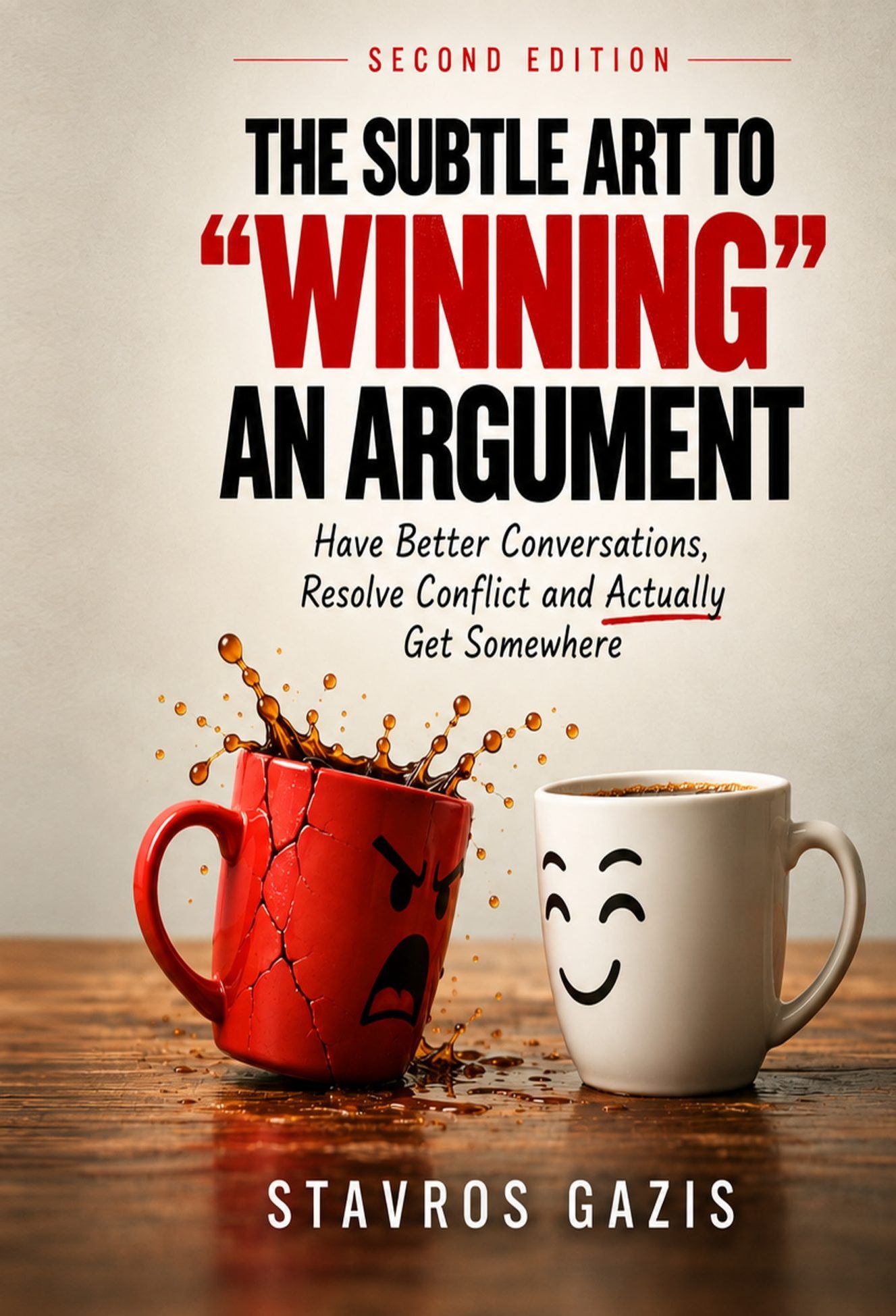
The Subtle Art of “Winning” an Argument
A book by Stavros Gazis
The Subtle Art of Winning an Argument
By Stavros Gazis · Mediator & Negotiator
Winning an argument is easy.
Getting anywhere useful afterwards is the difficult bit.
We know how to defend ourselves. We know how to find the
weak point in somebody else’s argument. We know how to
produce the perfect comeback three hours after the
conversation has ended.
The problem is that being right and getting somewhere
aren’t necessarily the same thing.
The Subtle Art of Winning an Argument is about
conflict, communication, negotiation and the strange things
people do once being right becomes more important than
solving the actual problem.
Written by mediator and negotiator Stavros Gazis, it looks
beyond clever comebacks and debate tricks to what is actually
happening when two people stop listening and start trying
to win.
Because sometimes the smartest way to win an argument
is to stop treating it like something that needs a winner.
Divorce & Separation
A book by Stavros Gazis
Divorce & Separation
The Sh*t Nobody Tells You
By Stavros Gazis · Mediator & Negotiator
They say divorce is like a death. Except the dead don’t WhatsApp you at 23:59 demanding the air fryer.
Well, before you assemble a legal army, recruit seventeen
friends to your side, diagnose your ex with three personality
disorders and spend R40,000 fighting over a kitchen appliance
neither of you particularly wanted, we should probably talk.
This isn’t a legal manual. It isn’t therapy. And it isn’t
another book telling you to breathe deeply, rise above it
and become the bigger person while your life is busy
disappearing up its own arse.
It’s about what actually happens when relationships end:
the anger, fear, ego, money, children, lawyers, stupid fights
and completely ordinary things that somehow become matters
of principle.
Written by mediator and negotiator Stavros Gazis,
Divorce & Separation: The Sh*t Nobody Tells You
looks at the conflict from the other side of the table —
and at the things people can do to stop an already difficult
situation becoming considerably worse.
So no, this book won’t teach you how to win your divorce.
It might help you do something considerably more useful.
Get through it without making it any harder than it already is.
Why Winning in Court Could Feel Like Losing
Hiring attorneys during personal or business disputes often escalates conflicts into destructive battles focused on winning rather than resolving underlying issues. Litigation can lead to significant financial, emotional, and relational damage, regardless of the final court outcome.
Mediation provides a diplomatic alternative aimed at practical problem-solving and preserving relationships or assets. While legal representation remains necessary in certain uncooperative cases, exploring mediation first helps parties achieve functional long-term resolutions without the severe fallout of court battles.
When you’re in a serious dispute, the first usual thought is to get an attorney.
And I can understand why. You’ve been screwed over. Your business partner has double-dealed, your marriage has fallen apart, or your family is fighting over an old estate. Someone owes you money and refuses to pay.
You want someone to fight for you. So you hire your Achilles. Your warrior. Someone who knows the law, knows the battlefield, and knows how to take the fight to the other side.
And it feels good. For the first time, you don’t feel like you’re standing there alone. You have someone on your side. You deserve this. You’re owed this victory.
But there lies the problem: that word, victory.
If there is a victor, it means there must be a loser. The moment that happens, the matter isn’t really a dispute anymore. This is now a war.
Turning a Dispute into a War
Once both sides hire their warriors, the escalation begins.
Your attorney attacks their position. Their attorney attacks yours. Letters start flying. Emails become evidence. Old WhatsApps suddenly become important. Endless nights are spent trawling through old Facebook posts, old photos, old messages, and countless screenshots of who said what.
Every little thing becomes another piece of ammunition. WhatsApps, emails, decade-old Facebook photos, all carefully scrutinized, catalogued, and sharpened, ready to be used to assassinate their character.
And naturally, it’s all perfectly justified.
You’re not attacking them: You’re exposing them.
You’re not being vindictive: You’re pursuing justice.
You’re simply doing your civic duty to reveal the villainy, set the record straight, and restore order to the universe, all nicely organized, and carefully labelled, in a Google Drive folder.
Before you know it, you’re no longer trying to solve the problem. You’re just trying to win at all costs with the patina of being known as “The Just”.
But that motive clouds a dangerous truth: “winning” can easily destroy the very thing you set out to protect. Why? Because war has no calculated control, especially when fueled by “it’s the principle of the thing.”
Fighting a war on principle can bankrupt you financially, morally, spiritually, or physically. There is always a price.
What Winning a War Actually Means
So let’s say you win. The judge hears your argument and agrees with you. You get the order you wanted. Congratulations.
Now what?
If you’re divorced, you still have to deal with your ex. If you have children, you still have to co-parent. If it’s a business dispute, you may still have employees, customers, and suppliers to deal with. If it’s a family dispute, you’re still related to the people you just spent months or years fighting.
The court has dealt with the legal issue, but you still have to deal with the aftermath.
A judge can make an order, decide who gets what, and enforce a contract. But a judgment doesn’t magically repair a relationship. It doesn’t give you back the years spent fighting, the lost sleep, or the personal toll it took on your health.
It doesn’t put the money spent on legal fees back into your bank account. And it certainly doesn’t make the person sitting across from you easier to deal with tomorrow morning.
Hire the Diplomat Before Starting a War
A mediator is your diplomat. They serve two vital purposes: helping strike a fair deal, and acting as the translator between two parties operating under completely different motives, agendas, emotions, and intentions.
This is exactly where mediation gets misunderstood.
Mediation isn’t about sitting around a table with an acoustic guitar on standby. It isn’t about holding hands and pretending everything is going to be fine. It isn’t about being weak, letting the other person get away with something, or giving up your legal rights.
Mediation simply means stopping for a moment to ask different questions.
Instead of asking, “How do I beat them?”, ask:
“What actually needs to be fixed?”
“What do I really want out of this?”
That is a completely different conversation.
Maybe the business needs to be split. Maybe one partner needs to buy the other out. Maybe the house needs to be sold, or parents need a workable arrangement for the children. Maybe there are five different problems hiding underneath one massive argument.
Those are practical issues you can work on in a diplomatic setting. You cannot resolve them in the arena, and you certainly won’t discover them through the fog of war.
When Do You Need an Attorney?
I’m not saying don’t hire an attorney. Sometimes you absolutely should. On occasion, a mediator will even suggest it themselves if they realize a matter cannot be resolved diplomatically.
There are situations where you need someone protecting your legal rights, where the other side refuses to negotiate in good faith, or where going to court is the only remaining option.
I’m not anti-attorney—quite the opposite. A good attorney is invaluable when you need one. I am simply anti-war, and I would rather explore a diplomatic discussion before launching the nukes.
Beware the Fallout
It’s easy to launch the nukes, reduce the other party to rubble, and claim you won the war. But very few people consider what happens when the dust settles: mopping up the fallout.
The blast radius of litigation often destroys the very thing you were trying to protect in the first place—your business reputation, your family structure, or your financial stability.
Before you send Achilles into battle, ask yourself the question almost nobody asks: “What will my life look like the day after I win?”
If the answer is that you’ll still have to deal with this person, run this business, or raise your children together, then winning the argument isn’t the whole answer.
The real objective isn’t to destroy the other side. It’s to walk away from the dispute with your life, money, business, and relationships intact.
That’s what makes mediation worth considering. Not because it’s softer, but because solving the problem is far more valuable than winning the war.
So before you call for Achilles, ask yourself: Do I need a warrior, or do I need a resolution?
Need structured, confidential support to resolve a dispute?
Blackthorn Resolute provides independent mediation and negotiation services across South Africa and internationally.
Understanding South Africa’s court-connected mediation rule
If you have received court papers and noticed a reference to Rule 41A of the Uniform Rules of Court, you are not alone. Many people assume it means they are being forced into mediation.
That is not what the rule says.
Rule 41A is the court’s way of asking an important question before litigation consumes months or years of time, money, and energy:
Have the parties considered mediation?
What is Rule 41A?
Rule 41A forms part of the Uniform Rules of Court used in the South African High Courts. It encourages parties involved in civil litigation to indicate whether they agree to refer the dispute to mediation.
When a party starts a civil action or application, they must usually deliver a Rule 41A notice stating whether they:
agree to mediation; or
oppose mediation.
If they oppose mediation, they must provide reasons for that decision.
What mediation means under Rule 41A
Mediation is a voluntary and confidential process in which an independent mediator helps the parties explore whether they can reach a mutually acceptable resolution.
The mediator does not:
act as a judge;
decide who is right or wrong;
impose a settlement on either party.
The parties remain in control of the outcome.
When does Rule 41A apply?
Rule 41A generally applies to civil disputes in the High Court, including matters such as:
commercial disputes;
contractual disputes;
partnership disputes;
property disputes;
damages claims;
certain family-related civil matters.
It does not automatically apply to every type of court proceeding, and some matters may be excluded by law or by the nature of the proceedings.
What happens if both parties agree?
If both parties agree to mediation, they can:
appoint a mediator;
agree on the mediation procedure;
schedule a mediation session;
attempt to resolve some or all of the dispute.
If an agreement is reached, it can often be recorded in writing and, where appropriate, made an order of court.
What if one party refuses?
A party may refuse mediation, but the refusal must usually be stated formally. Courts increasingly expect litigants to genuinely consider mediation, especially where it could save significant costs and court time.
Refusing mediation is not automatically wrong, but parties should be able to explain why mediation would not be appropriate in the circumstances.
Why Rule 41A matters
The rule reflects a broader shift in South African civil justice toward resolving disputes more efficiently and constructively.
Litigation is sometimes necessary. But many disputes involve ongoing relationships, business connections, neighbours, or family members where a negotiated solution may be more effective than a judgment delivered years later.
The key question
If you have received a Rule 41A notice, do not panic. The notice is not a judgment against you, and it does not mean you have already lost your case.
The real question is:
Would mediation help resolve this dispute more effectively than continuing the fight through court?
Understanding that question is often the first step toward deciding whether Rule 41A is simply another form to complete — or an opportunity to resolve the conflict before it becomes far more expensive and damaging.
Contact us for a free 30 minute Initial Consultation for more information.
Rule 41A for Businesses and Commercial Disputes
Why mediation can make commercial sense
When business owners hear the word mediation, many assume it is mainly for divorce or family disputes. In reality, Rule 41A can be particularly valuable in commercial and business conflicts.
Business litigation is expensive. It consumes management time, damages relationships, creates uncertainty, and can distract a company from its core operations for months or even years.
Rule 41A creates an opportunity to ask a different question:
Can this dispute be resolved in a way that protects both the business and the relationship?
Common commercial disputes suitable for mediation
Rule 41A mediation may be useful for disputes involving:
breach of contract;
unpaid invoices or service fees;
partnership disagreements;
shareholder disputes;
supplier or distribution conflicts;
construction and service delivery disputes;
property and lease disputes;
professional service disagreements.
These matters often involve ongoing commercial relationships where a complete breakdown is costly for everyone involved.
The hidden cost of commercial litigation
A business owner may focus on the legal claim itself, but litigation usually creates additional costs:
directors spending time with attorneys instead of running the business;
employees being drawn into the dispute;
cash flow being tied up;
damaged reputations;
lost future opportunities with customers, suppliers, or partners.
Sometimes the dispute is worth less than the total cost of fighting it to trial.
What mediation offers businesses
Commercial mediation provides several advantages that court proceedings often cannot.
Confidentiality
Court proceedings are generally public. Mediation is confidential, which is particularly important where pricing, contracts, intellectual property, or sensitive business relationships are involved.
Flexibility
A court is limited to the remedies available in law. Mediation allows parties to create practical commercial solutions, such as:
revised payment terms;
future supply arrangements;
phased settlements;
joint projects;
revised partnership structures;
non-financial commitments that preserve the business relationship.
Speed
A mediation can often be arranged within weeks, whereas commercial litigation may take years before reaching trial.
Rule 41A and commercial strategy
Agreeing to mediation under Rule 41A is not a sign that your business has a weak case. Strong commercial parties often use mediation because it allows them to:
assess the other side’s position;
explore settlement options confidentially;
reduce legal costs;
narrow the issues if litigation continues;
maintain greater control over the outcome.
A judgment imposed by a court may provide legal certainty, but it may also destroy a profitable business relationship that could have been repaired through negotiation.
Example: Partnership dispute
Imagine two business partners disagree about profit distributions and management decisions.
A court can determine whether certain actions breached the partnership agreement. But the deeper conflict may involve:
lack of trust;
unequal workloads;
poor communication;
different visions for the business;
resentment that has built up over time.
A legal ruling might resolve the contractual question while leaving the underlying business relationship permanently damaged. Mediation creates space to address both the legal issues and the commercial realities.
When litigation is still necessary
Mediation is not always appropriate. A business may need urgent court intervention where there is:
fraud or theft;
unlawful competition;
urgent interdicts;
asset dissipation;
refusal to comply with contractual obligations that require immediate enforcement.
In many other commercial disputes, however, mediation can be attempted before committing to the full cost and uncertainty of trial.
Final thought
For businesses, Rule 41A should not be viewed as an administrative hurdle attached to court papers. It should be viewed as a commercial decision point.
The question is not simply:
“Can we win this case?”
The more important question is often:
“What is the most commercially sensible way to resolve this dispute while protecting the future of the business?”
That is where commercial mediation can become a strategic advantage rather than a compromise.
What Happens After You Receive a Rule 41A Notice?
A practical step-by-step guide for South African litigants
Received a Rule 41A notice? It means mediation has formally been raised in your High Court matter. It does not mean the court has ruled against you, and it does not automatically require you to settle. However, there are procedural requirements you should not ignore.
Receiving a Rule 41A notice can be intimidating, especially when you’re already dealing with the stress and expense of litigation.
The important thing is to understand what the notice means, what you need to do next, and whether mediation could offer a practical way forward.
Step 1: Read the notice carefully
A Rule 41A notice generally indicates whether the other party agrees to or opposes referring the dispute to mediation, together with brief reasons.
Check the following:
The case number and court division.
Whether the other party agrees to or opposes mediation.
The reasons provided.
The stage of the proceedings.
The deadlines applicable to your own court documents.
Important: Receiving a Rule 41A notice does not, by itself, suspend your court deadlines.
Step 2: Understand when you must respond
Under Rule 41A(2), a defendant or respondent must generally serve their own mediation notice when delivering their notice of intention to defend or oppose, or afterwards but no later than their plea or answering affidavit.
The notice must indicate whether you agree to or oppose mediation and briefly explain why.
Urgent applications and applicable court practice directives may affect the procedure.
Do not confuse a Rule 41A notice with a summons, notice of intention to defend or other pleading. Each has its own procedural purpose.
If you are uncertain about your deadlines, obtain legal advice promptly.
Step 3: Ask yourself what the real dispute is
Before deciding whether mediation is appropriate, consider what actually needs to be resolved.
Is the dispute primarily about a legal principle that requires judicial determination? Or is there room for a negotiated solution that both parties could accept?
For example, a commercial contract dispute might involve outstanding payments, disputed performance or a breakdown in the business relationship.
Even where legal questions exist, mediation may help resolve some practical issues without requiring the parties to agree on every legal argument.
Mediation does not require either party to abandon their legal rights simply to participate.
Step 4: Decide whether to agree to mediation
Under Rule 41A, your formal notice indicates whether you agree to or oppose mediation, with reasons.
If you agree
The parties can discuss appointing an independent mediator, identifying the issues to be addressed and arranging the mediation process.
If you oppose
You should provide concise reasons why you believe the dispute is not capable of being mediated.
If you need more information
You can discuss practical concerns such as timing, costs, the mediator’s independence or the scope of mediation.
However, these discussions do not replace the formal notice requirements.
A willingness to consider mediation does not mean you must accept an unfavourable settlement.
Step 5: What happens if both parties agree?
Where a dispute is formally referred to mediation under Rule 41A, the parties must deliver a signed joint minute recording their decision and enter into an agreement to mediate before the process begins.
The parties will ordinarily need to agree on:
The appointment of an independent mediator.
Whether mediation will take place online or in person.
The issues to be discussed.
The sharing of mediation costs.
The involvement of attorneys or other advisers.
The practical arrangements for the sessions.
Unless the parties agree otherwise, Rule 41A provides for the mediator’s fees to be shared equally between participating parties.
Does mediation suspend court deadlines?
Under Rule 41A(4), the prescribed procedural time limits are generally suspended from signature of the required joint minute until mediation concludes, subject to the rule’s provisions.
Mediation is ordinarily to be concluded within 30 days of signing that minute, unless the court or a judge grants an extension on good cause shown.
Do not assume deadlines are suspended merely because mediation has been proposed or discussed.
Step 6: What should you prepare?
You do not need to prepare courtroom-style arguments. Mediation is a facilitated negotiation, not a trial.
Useful preparation may include:
Relevant contracts or agreements.
Correspondence between the parties.
Court papers already filed.
A clear list of the issues in dispute.
Your priorities and practical concerns.
Possible settlement options you would consider.
It is also worth asking yourself a simple question:
What would a workable resolution actually look like?
That answer may be more useful than preparing another argument about who is right.
What if mediation fails?
If mediation does not produce a settlement, unresolved issues can generally continue through litigation.
The process may still help the parties narrow the dispute, identify areas of agreement or better understand each other’s positions.
Rule 41A also contains confidentiality protections, subject to its stated exceptions.
A mediator cannot impose a settlement simply because the parties have participated.
What is the biggest mistake to avoid?
Ignoring the procedural requirements.
A Rule 41A notice is part of formal High Court proceedings. Treat it seriously, establish what is required of you, and obtain legal advice where necessary.
But do not confuse taking the notice seriously with assuming that litigation is your only option.
Sometimes mediation provides an opportunity to resolve a dispute before further time, expense and uncertainty accumulate.
Need an independent mediator for your Rule 41A matter?
Blackthorn Resolute provides independent mediation services for suitable civil, commercial and other disputes.
We offer online mediation throughout South Africa and in-person services in Johannesburg and the Vaal Triangle, with other locations by arrangement.
Our standard mediation rate is R950 per hour, and we offer a free initial 30-minute consultation to discuss your situation and the suitability of mediation.
You do not need to have persuaded the other party to mediate before making an enquiry.
Received a Rule 41A notice, or considering mediation for an existing dispute?
Blackthorn Resolute provides mediation services, not legal representation. For legal advice concerning court procedures, deadlines or your rights, consult a qualified legal practitioner.
Understanding your rights and the practical consequences
One of the first questions people ask after receiving a Rule 41A notice is:
“Can I refuse mediation?”
The short answer is yes — Rule 41A does not automatically force parties to settle their dispute through mediation.
However, the more useful question is:
“What happens if I refuse?”
But, because the matter may be sensitive, let’s us the work Decline instead of Refuse.
What Rule 41A requires
Under Rule 41A of the Uniform Rules of Court, parties involved in certain civil proceedings are generally required to indicate whether they agree or oppose mediation.
If a party opposes mediation, they must usually provide reasons for that opposition.
The rule encourages parties to consider mediation seriously, even if they ultimately decide not to participate.
Legitimate reasons for declining mediation
Mediation is not appropriate in every case. Examples where declining may be reasonable include:
the matter requires an urgent court order;
a legal precedent is needed;
there are allegations of fraud that require judicial determination;
one party is refusing to disclose essential information;
there is a significant power imbalance that cannot be managed properly in mediation;
previous mediation attempts have failed and circumstances have not changed.
Simply being angry with the other party is usually not a strong reason on its own.
What courts are increasingly looking for
South African courts are placing greater emphasis on the efficient use of judicial resources. Judges are increasingly interested in whether parties have made genuine attempts to resolve disputes without unnecessary litigation.
This does not mean the court will punish every refusal. It means that a party who declined mediation should be able to show that the decision was reasonable in the circumstances.
The practical risks of declining mediation
Declining mediation may lead to:
increased legal costs;
longer delays before trial;
a perception that the party was unwilling to explore settlement options;
missed opportunities to resolve at least part of the dispute.
In some matters, even partial agreement on a few issues can significantly reduce the scope and cost of the litigation.
Agreeing to mediation does not mean agreeing to settle
This is an important distinction.
Many people fear that saying “yes” to mediation means admitting weakness or accepting the other side’s demands.
It does not.
Agreeing to mediation simply means you are willing to participate in a structured discussion with the assistance of a neutral mediator. You remain free to:
reject proposals;
request legal advice;
end the mediation if it is not productive;
continue with litigation if no agreement is reached.
A useful test
Before declining mediation, ask yourself:
Do I need a judge to decide this issue?
Is there any realistic possibility of negotiation?
Would a settlement save significant time or money?
Is there an ongoing relationship that will continue after the court case ends?
If the answer to the last question is yes — for example, co-parents, business partners, neighbours, or family members — mediation is often worth considering even when emotions are high.
Final thought
Yes, you can decline mediation under Rule 41A.
But the real issue is not whether declining is legally possible. The real issue is whether declining mediation moves you closer to a better outcome or simply commits you to a longer, more expensive, and potentially more damaging fight through the courts.
Preparing for a Rule 41A Mediation Session
How to get ready for court-connected mediation in South Africa
If you have agreed to Rule 41A mediation, proper preparation can make the difference between a productive session and a frustrating day where nothing moves forward.
Many people arrive at mediation expecting a courtroom. That is usually a mistake. Mediation is not a trial, and success depends less on winning arguments and more on understanding the problem clearly and exploring realistic solutions.
Understand the purpose of the session
The goal of Rule 41A mediation is not for the mediator to decide who is right. The goal is to help the parties determine whether they can reach a voluntary agreement that resolves some or all of the dispute.
This means you should arrive prepared to:
explain your concerns clearly;
listen to the other side’s position;
evaluate settlement options realistically;
make informed decisions about possible outcomes.
Gather the important documents
Before the session, collect the documents that are genuinely relevant to the dispute. Depending on the matter, this may include:
contracts or agreements;
invoices and payment records;
correspondence and emails;
court pleadings already filed;
photographs or supporting evidence;
timelines of important events;
calculations relating to damages or amounts claimed.
Organise the documents in chronological order if possible. A clear file often saves significant time during the mediation.
Prepare a short summary
One of the most useful exercises is to prepare a one-page summary answering three questions:
1. What happened?
Describe the key events briefly and factually.
2. Why is it a problem?
Explain the practical impact on you or your business.
3. What outcome could you realistically live with?
Notice that this is different from asking “What do I ideally want?” Mediation works best when parties distinguish between their ideal outcome and an outcome they could reasonably accept.
Think beyond positions
A position is what you say you want.
Examples:
“I want R500,000.”
“I want full control of the business.”
“I want the other party to admit they were wrong.”
An interest is the underlying reason behind that position.
Examples:
financial security;
certainty about future payments;
protection of a business reputation;
recognition of your contribution;
the ability to co-parent effectively.
Mediation becomes much more effective when parties identify their underlying interests rather than only defending their positions.
Decide who should attend
Make sure the people attending the mediation have authority to make decisions. A session is often wasted when someone attends only to “listen” but cannot approve any settlement proposal.
If attorneys are involved, clarify in advance:
whether they will attend;
what role they will play;
how decisions will be made during the session.
Prepare emotionally as well as legally
Rule 41A mediations often involve significant frustration, anger, or disappointment. Before the session, ask yourself:
What issues trigger the strongest emotional reaction in me?
What am I most afraid of losing?
What would make me feel that the process was fair, even if I do not get everything I want?
Being aware of these reactions beforehand helps you respond more constructively during the mediation.
Common mistakes to avoid
Arriving without preparation
Mediation is informal, but it should not be treated casually.
Treating mediation like a courtroom battle
The goal is not to impress the mediator with legal arguments.
Refusing to consider any movement at all
If both parties arrive determined to make zero concessions, the mediation is unlikely to succeed.
Focusing only on the past
The past matters, but mediation is ultimately about what happens next.
What success looks like
A successful Rule 41A mediation does not always mean that every issue is resolved immediately. Success may include:
settling the entire dispute;
resolving some of the issues;
agreeing on a payment structure;
narrowing the questions that must go to court;
improving communication enough to continue negotiations productively.
Even partial progress can save substantial legal costs and reduce the time required to finalise the matter.
Final thought
The parties who benefit most from Rule 41A mediation are usually not the ones with the loudest arguments. They are the ones who arrive understanding three things:
What matters most to them.
What they are realistically willing to accept.
What kind of future they want after the dispute is over.
Good preparation does not guarantee settlement.
But it gives you the best possible chance of turning a court-connected mediation into a practical, informed, and constructive opportunity for resolution rather than simply another expensive step in the litigation process.